





Temporary Fencing Is a Business Decision: Here's How to Make the Right One
Every construction project, public event, and commercial worksite eventually faces the same question: what goes up around the perimeter, and how fast does it need to happen?
JTI Fence has spent 5 years working with business owners and contractors across Northern Washington, and temporary fencing comes up more often than most people expect. From active construction sites in Bellingham to seasonal events and waterfront projects near the bay, temporary fencing plays a critical role in maintaining operational organization and compliance.
Temporary fencing controls access, protects the public, defines work zones, and keeps a project aligned with local safety requirements. In a region where projects often deal with wet ground, public foot traffic, and changing weather conditions, a poorly planned fence setup can quickly become a liability.
Temporary Fencing Is Not One-Size-Fits-All
The phrase "temporary fencing" covers a wide range of applications, and the right solution depends entirely on the site's requirements. A construction perimeter around a multi-month commercial build has different demands than a weekend event in a park or a utility access point that needs to stay secured for two weeks.
Sites near downtown corridors, parks, or mixed-use developments also tend to see steady pedestrian traffic. That means fencing needs to do more than just mark a boundary; it needs to stay stable, visible, and secure throughout the duration of the project.
Working through a few baseline questions helps narrow down the right solution:
- How long does the fence need to be in place?
- What level of security or visibility does the site require?
- Are there foot traffic or vehicle access points that need to be incorporated?
- Does the installation need to meet specific municipal or permitting requirements?
- Will the fence need to be repositioned as the project progresses?
The answers to these questions shape everything from the panel type and post system to whether a windscreen or privacy screen is needed.
Common Applications for Temporary Commercial Fencing
Commercial clients use temporary fencing across a broader range of situations than most people initially consider. Some of the most frequent applications in the Whatcom County Washington fencing market include:
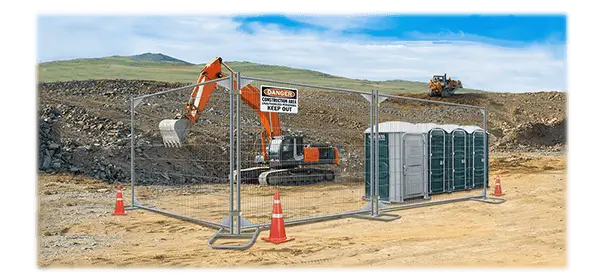
- Construction sites are the most obvious use case. Temporary chain link panels create a defined perimeter, keep unauthorized individuals away from hazardous areas, and satisfy OSHA and local safety requirements. Larger sites also benefit from panels that organize internal traffic flow and separate active work zones from staging areas.
- Special events rely on temporary fencing for crowd management, entry control, and VIP or vendor area separation. The setup needs to go up quickly, hold up throughout the event, and come down without damaging the venue or the surrounding grounds.
- Utility and infrastructure projects often require access control around equipment, open excavations, or hazardous materials. These applications require fencing that can be quickly configured and repositioned as the work area changes.
- Vacant properties and demolition sites need perimeter control to limit liability and deter unauthorized entry. A well-installed temporary fence communicates that a site is actively managed, which matters both for insurance purposes and community perception.
- Emergency situations sometimes require fencing to go up fast. Storm damage, structural failures, and contamination events all create immediate perimeter needs that can't wait for a permanent solution.
What Makes a Temporary Fence Installation Actually Work
The quality gap between a well-installed temporary fence and a poorly installed one becomes obvious quickly. Panels that shift, lean, or blow over in the wind pose safety hazards and delay projects. A temporary fence that fails is worse than no fence at all because it creates a false sense of security while leaving the site exposed.
Several factors separate reliable temporary fencing from the kind that causes problems:
- Post and base systems need to match site conditions, especially in soft, wet, or uneven ground and areas exposed to wind.
- Panel connections should be secure enough to prevent gaps from opening up under normal conditions, including foot traffic and wind-exposed areas, especially near open land or waterfronts.
- Gate placement needs to be planned before installation, not added as an afterthought. Access points that aren't positioned correctly create workflow problems that compound over time.
- Bracing at the corners and ends of runs prevents the cascading lean that can develop when a long panel line loses structural support at a single point.
A Northern Washington commercial fence contractor who has worked through these variables on real job sites will catch these issues before they become problems. Experience with local conditions matters because the Whatcom County Washington climate, with its wind and wet ground, presents challenges distinct from those in other regions.
Temporary Fencing and Compliance
Commercial projects in Northern Washington are subject to safety and permitting requirements that often specify fencing standards. Construction sites near public rights-of-way, properties adjacent to schools or parks, and projects with specific hazard classifications all carry their own sets of regulations.
A few compliance areas that commercial clients frequently need to address include:
- Minimum height requirements for construction site perimeters
- Visibility and reflectivity standards for fencing near roadways
- Requirements for signage attached to or incorporated into the fence line
- Permitting for temporary structures in certain municipalities
Working with an experienced fencing contractor means having a team that understands these requirements and can help ensure the installation meets them from the start, rather than discovering a compliance issue after the fence is already up.
Planning the Timeline
Temporary fencing projects that run into trouble often do so because the fencing wasn't included in the project timeline until the last minute. Lead times for panel availability, site assessment, and installation scheduling need to be factored in, particularly during the peak construction season when demand is high.
A few timeline considerations that commercial clients should keep in mind:
- Contact a fencing contractor early in the project planning process, not the week before work begins.
- Account for potential permitting delays if the project is in a municipality that requires approval for temporary structures.
- Plan for fence repositioning if the project has multiple phases that change the required perimeter over time.
- Built-in time for a site walkthrough so the contractor can assess ground conditions, access points, and any site-specific challenges before the installation day.
JTI Fence Serves Commercial Clients Across the Region
JTI Fence is a family-owned Northern Washington commercial fence contractor with 5 years of experience serving construction companies, property managers, event coordinators, and business owners across the region.
The team brings the same commitment to workmanship in temporary installations as it does in permanent fencing projects, because a fence that's only up for a few weeks still needs to do its job reliably the entire time it's there.
The right temporary fence keeps a project moving, keeps the public safe, and keeps the business protected. Call JTI Fence at (360) 526-2628 to discuss your project requirements, or contact us online to schedule a site consultation.